Pages

Wednesday, November 12, 2014

Steve Carell and Channing Tatum Excel Like Never Before in Quiet and Physical "Foxcatcher"

(Photos by Michael Iannucci)
Though stars Steve Carell and Channing Tatum have shown glimpses of serious acting chops throughout their careers (Carell’s most notably coming in 2006’s Little Miss Sunshine and Tatum’s in 2012’s Magic Mike), those have been few and far between until now. The two have, for the most part, stuck to lighter, somewhat silly films (sometimes intentionally, sometimes not), but director Bennett Miller’s “Foxcatcher” is anything but that.

The film is based on the true story of Olympic wrestling champion brothers Mark (Tatum) and Dave (Mark Ruffalo) Schultz and their path to the 1988 Seoul Olympic Games after eccentric millionaire John du Pont (Carell) becomes personally invested in their careers. Following his 1984 gold medal win, Mark lives a solitary life consisting of little more than training with his brother, who is already a settled family man, and occasionally speaking at schools for some much needed cash. Quiet and brooding, he is clearly unsatisfied with his current situation. As he goes about his everyday life, arms wide and shoulders tense, only speaking when spoken to, he resembles a caged animal and in his interactions with Dave, he is the baby brother wanting to step out of Dave’s more celebrated shadow. 

After being mysteriously called upon to visit the home of du Pont and learning that the philanthropist wants to sponsor Mark’s career, Mark is boyishly elated. He moves out to du Pont’s estate to train, where he becomes a member of “Team Foxcatcher” (the name of the horse racing stable du Pont’s father once kept). The two develop a close father-son relationship, but it is eventually interrupted when du Pont convinces Dave to move his family and join them.

There is a pervading quietness to the film that gives way to a sense of dread. Scenes go by with very few words being spoken, yet the intensity is always such that an explosion seems imminent. This is in part owed to the understated direction by Miller, who has thrived on presenting biographical stories in a hushed tone, just as he did in his previous two films, “Capote” (2005) and “Moneyball” (2011). Carell’s creepy du Pont and Tatum’s physically explosive Mark are center of the atmosphere, however. Du Pont’s exaggerated prosthetic nose, pompous yet insecure gait and slow speaking pattern highlight a man whose own ridiculous behavior is hiding serious mental instability. Though he is physically present, his mind is far off screen. Mark, meanwhile, is a squarish muscle mass who hides behind a scowl until he is driven to physical combustion. When the two are on screen together, the tension is incredible.

Despite the film being a wholly serious endeavor, there are moments that are darkly funny. Du Pont’s relationship with his mother (Vanessa Redgrave), who turns out to be a major figure looming behind du Pont’s mental unsteadiness, brings an occasional uneasy laugh. So too does his self-obsession, which borders on the pathetic. His friends call him “golden eagle,” or so he says.

While the film’s quiet nature is a part of what makes its physicality all the more powerful, it is, at times, too quiet for its own good. The film loses a bit of its steam in its final act, but one conclusive explosion in that same act is compelling enough to redeem the slow moments.
  
Although Ruffalo often plays referee to the Carell and Tatum show, his performance would be towering in many other films and is the best from the actor in quite some time. Tatum’s performance on the wrestling mat is also something to behold; much like Natalie Portman’s dazzling performance as a ballet dancer in 2010’s “Black Swan,” Tatum appears to have mastered the craft of the mat in preparation for the role he called “the hardest acting challenge I’ve had to date.”

Overall, “Foxcatcher” is an emotionally distant, yet powerful biographical drama about troubled men who speak little of what they feel but can do little to hide it in their often-volatile actions. In that setting, performances inevitably come to the forefront, and given the chance, Carell and Tatum shine like never before. (Grade: B+)

Foxcatcher comes out Friday, November 14 in select theaters

Wednesday, October 8, 2014

Paul Thomas Anderson's "Inherent Vice" is a Visceral Experience, Even If It Does Confuse

(Photos courtesy of Warner Bros/NYFF)
Paul Thomas Anderson’s new film, “Inherent Vice,” asks an important question of its viewers: Where does a coherent plot factor into what makes a movie “good” or “bad?” If you place heavy importance on plot, then you will likely leave the film extremely frustrated. If you tend to rely on the feel of a film rather than specifically what is going on and why, however, then you will find it a hypnotic experience unlike anything else in cinema. 

It comes as no great surprise that the film’s helmer himself is an advocate of the latter contention. At his “On Cinema” masterclass at the New York Film Festival, where “Inherent Vice” premiered to mixed reviews this past weekend, Anderson stated: “I never remember plots in movies. I remember how they make me feel. I remember emotions and I remember visual things that I’ve seen and my brain has just never connected the dots of how things go together.” This almost seems to be an indirect response to the early criticism of his film, which almost entirely centered on its confusing plot. While it is certainly reasonable to be put off by a movie that (so far) seems to universally confuse, there is far too much else to “Inherent Vice” to simply write it off.

The film follows Doc Sportello, an often-stoned hippie private eye with long greasy locks and prominent mutton chops (played by a typically excellent Joaquin Phoenix), as he tries to appease ex-girlfriend Shasta (exciting newcomer Katherine Waterston) by investigating the disappearance of her new lover. Set in a drugged out ‘70’s Los Angeles with a hazy noir feel, Doc must weave his way through a maze of characters ranging from a saxophone player turned undercover cop (Owen Wilson) to a cocaine addict dentist (Martin Short), who is not above corrupting a young blonde patient of his, in order to find out just what the heck is actually going on.

The rest of the ensemble cast includes Josh Brolin, who plays Bigfoot, a hippie-hating cop who harasses Doc every chance he gets, Benicio Del Toro, Reese Witherspoon, Maya Rudolph, Jena Malone, and musician Joanna Newsom, who narrates the film. While the plot can at times be even more confusing than it sounds, perplexity is actually a part of this film’s charm, something it owes to its source material, the novel of the same name by famously reclusive novelist Thomas Pynchon. This marks the first time that Pynchon has allowed one of his novels to be adapted to the big screen, and according to his readers, the chaotic nature of the film can be directly traced back to the novel.

“It was a bit episodic and there was a sort of jumping from stone to stone to stone and sometimes these connected pieces were made in the book, sometimes they weren’t. There were various blind alleys and dead end streets,” said Anderson of adapting the novel.

Indeed, the film has a rapid pace and often the viewer is introduced to characters and situations that quickly disappear and end up having no real bearing in anything. That’s life; everything is not going to directly tie into everything else. In the detective field, that must be dealt with regularly. In that way, “Inherent Vice” honors realism, but it is really its surrealism that is eye catching.

In the lead up to the film’s first viewings, most expected Anderson to return to his “Boogie Nights” roots. In other words, most expected a lighter and more formal ensemble comedy. Instead, the film is much closer to Anderson’s most recent film, “The Master,” in its look and feel. Throughout that film, there are moments that although apparently embedded in reality, feel surreal. An apparent dream that ends up having some bearing in actuality towards the end of the film comes to mind. The same can be said of many moments in “Inherent Vice,” such as an odd trip to a psychiatric hospital by Doc.

Despite all of its outrageous comedic elements, there is a brooding sadness just below the surface of “Inherent Vice”. Pynchon readers say this is also present in the novel. However, it is also a common theme in Anderson’s work. In “The Master,” beneath lead character Freddie Quell’s (also played by Phoenix) corrosive veneer, there is a very detectable sorrow. The same can be said of most Anderson protagonists, but “Inherent Vice’s” contrasting tone is highlighted by raw, often sensual camerawork and an eventual sense of self-discovery by the protagonist, just as it is in “The Master.” Also, at the heart of the two stories are a girl and the regret of love lost, both of which come to an explosive peak in an incredible long-take between Doc and Shasta in “Inherent Vice.”

It is interesting to note that Anderson has reteamed with cinematographer Robert Elswit for “Inherent Vice.” The two worked together for all of Anderson’s films except “The Master,” yet the look they create in this is closer to that film than any of their past collaborations.

Fans of Anderson will most certainly be pleased with all of this, but the film interestingly has the guns to keep general audiences satisfied as well despite its plot difficulties. The part deadpan, part outrageous stoner comedy script is hilarious. Look for the film to gain cult status among the same group that holds films like “The Big Lebowski” so high. Because of this, it should serve as a confirmation of Anderson as one of the most versatile directors in the world today. Also, the environment is so rich and expertly crafted that is will likely compel both those who lived through it and those who did not.

The score, another product of the Anderson-Jonny Greenwood marriage now in its third film, is fun and an effective match to its on-screen material. It features everything from Neil Young’s “Harvest” to original work by Greenwood. Performances of the actors are as compelling as one would expect from such a talented cast, particularly Phoenix and Waterston (although Brolin just might be a show stealer of sorts).

Overall, complaints of a confusing plot feel weak in comparison to all that “Inherent Vice” has going for it. Cinematic history is riddled with confusing films that have nonetheless been deemed masterpieces. Take “2001: A Space Odyssey,” for example. Widely considered to be lofty among the greats, the film is also considered to be one of the more confusing films in history. If someone could explain the entire plot beginning to end without theorizing, they’d be the first. So the question then becomes, if deeply serious films can become revered without an entirely discernible plot, then why can’t comedies? Especially one as beautifully crafted and spellbinding as “Inherent Vice.” (Grade: A-)

Monday, October 6, 2014

Takeaways from "On Cinema: Paul Thomas Anderson" Include How Charles Manson Ruined It for the Hippies, an "Interstellar" recommendation and a Grimes Music Video

Paul Thomas Anderson talks with New York Film Festival Director, Kent Jones, during his masterclass at the festval.
(Photo by Michael Iannucci)

Just a day after Paul Thomas Anderson's hotly anticipated new film, "Inherent Vice," premiered as the New York Film Festival's centerpiece, the revered American director took the stage at Alice Tully Hall to talk all things film in the festival's annual "On Cinema" masterclass. Topics of discussion ranged from "Inherent Vice" and influences to the revelation that Anderson has seen and highly recommends Christopher Nolan's upcoming "Interstellar." While my review of "Inherent Vice" is still on the way (it is a lot more to digest than I anticipated), here are some highlights of Anderson's masterclass:

On Neil Young's "Journey Through the Past":

“It just looks like my idea of heaven on a Saturday afternoon, cruisin’ around with your girl and parking with a brook nearby and taking a joint out and eating strawberries. I don’t know how it could get any better honestly.”

On how Charles Manson ruined the perception of hippies:

“There’s a passage in Inherent Vice the book (that didn’t make the movie), but it was this discussion between Bigfoot and Doc, and they’re talking about what happened with Manson and how it just fucked everything up for all these hippies because it used to be that the straight world would just look at them and think ‘Oh look how cute they are! They’re kind of like monkeys in a zoo; the husband is carrying the baby and the mom is paying for the groceries’ and everyone treated them like cute caged animals and then Manson came along and suddenly it was ‘Stay away, they might mass murder all of us’ so there was this shift.”

On Robby Müller's cinematography in "Repo Man" and its relation to shooting on film:

“I’m always trying to get night interiors to look like Robby Müller did and I can never do it. I don’t know how he did it. It doesn’t look like there’s any lights on; it looks like how it really looks. And there’s gotta be a million lights on! I just don’t know how he did it. It’s like a magic trick. He had a magic with it that I can’t quite figure out. It’s something to look for in his photography that he was a master at. There are people who are good at certain things and he was a master at night interiors, which can be very difficult.”

“I would hate to think that there won’t be more artists like Robby Müller out there knowing the art of movie lighting. To be good at movie lighting is like a life-long job; to be skillful at it; to be great at it. So skillful, and that skill was required from them because they were shooting on film. I don’t want to say anything bad here but the skill level has been diminished when you shoot at night and you don’t need to put any lights up because you don’t need to put any lights up. And I would hate to think that that is going to be lost; that the job of someone who can light a movie set would go away.”

(Photo by Michael Iannucci)
On doing movie lighting in post-production: 

“That’s fucking cheating!”

On plot and "North by Northwest":

“I never remember plots in movies. I remember how they make me feel. I remember emotions and I remember visual things that I’ve seen and my brain has just never connected the dots of how things go together. This movie ('North by Northwest') in particular was a huge help getting ready for 'Inherent Vice' because I knew there was just so much ground to cover and it was a bit episodic and there was sort of jumping from stone to stone to stone and sometimes these connected pieces were made in the book, sometimes they weren’t. There were various blind alleys and dead end streets and all that kind of stuff. It was a helpful reminder to go back to this film and feel that energy again and feel a kind of looseness.”

“If emotional logic is betrayed, then you’ve got a problem. There’s a fine line between ‘No fucking way!’ and ‘Yeah, yeah, I could see that happening.’ If you start messing with the plausibility of someone’s emotions, that feels against the rules a little bit.”

On Quentin Tarantino, the state of film shooting and Christopher Nolan's upcoming "Interstellar":

“Quentin’s a film nerd too, I suppose; it’s a small group of us that’s hopefully growing and sticking together. Quentin’s much more vocal about it though. He wants to tar and feather people over it. I think at the moment things are going around where genuinely there’s such concern and fear in the air about film not even being an option. There really is a movement among filmmakers right now to sort of desperately encourage filmmakers that are coming up, filmmakers that are around and are producing stuff right now that to, if you have a choice, please shoot film. Chris Nolan is sort of at the front lines of all this, I have to say. He’s made a beautiful film. Everybody should get out and see 'Interstellar' when it comes out. But don’t fuck around; go see it in IMAX. Brave the line.”

On the music video for Oblivion by Canadian singer-songwriter Grimes (directed by Emily Kai Bock):

“That gets me going. It’s fucking great. I just saw it and it made me hyper and it made me bounce around the room. I just wanted to bounce off the walls. Not just a great song (‘cause it is a great song) but when everything comes together perfectly; you have a great song, you’ve got this great performer; this great artist matching up with these visuals and everything clicks. Taking her into a real situation; taking this amazing performer into a real situation, and it’s spooky too. It gets you pumped up and makes you want to dance but there’s something spooky about it. It’s so graceful the way she does that. There’s a really good energy, but that kind of energy that starts to get a little bit crazy and a little fevered when you see some of the faces that she got. These kind of frat guys bouncing around and they seem all too real and all too date rapey. So there’s that danger lurking underneath it, but on top of it, it just kind of makes me want to dance.”

On composer Jonny Greenwood's work in "Inherent Vice":

“With 'Inherent Vice' he plays a little bit of guitar, which is nice; sort of a first. He’s sort of reluctant to pick up the guitar sometimes, but the movie called for it. There’s one piece in particular towards the end that he’s had for a number of years with no where to go and it found a really nice home in this film.”


Sunday, September 28, 2014

"The Disappearance of Eleanor Rigby: Them" is an Original Debut for Writer-Director Ned Benson

"The Disappearance of Eleanor Rigby" was originally split into "Him" and "Her" perspective cuts before being combined into "Them" to shorten the film's running time. 
Jessica Chastain’s star seems to be ever rising, even if her pace has slowed a bit since 2011’s ridiculous seven-film burst into the spotlight.  With a resume already featuring Academy Award nominated performances for polar opposite roles in “The Help” and “Zero Dark Thirty,” the versatile American actress may have just turned in her most complete performance to date in “The Disappearance of Eleanor Rigby: Them.”

The film has an interesting back-story. Its original release came at last year’s Toronto International Film Festival where it ran a total of 191 minutes split between two different parts titled “Him” and “Her.” The two parts tell the same story of a married couple reeling in the wake of extreme tragedy, but “Him” is shown through the eyes of Conor (James McAvoy) while “Her” is shown through those of his wife, Eleanor (Chastain). The project was widely well received as an ambitious look at the different perspectives involved in a marriage in crisis, but its bladder-challenging running time made the prospects of a wide release tough. As a result of this, a third cut of the film was prepared entitled “Them,” featuring both perspectives fused into a commercial friendly 123 minutes. “Him” and “Her” are set to be released in select theaters in October nonetheless, but “Them” is currently screening in theaters nationwide.

It remains to be seen whether the reduced “Them” cut has lost anything significant in the editing room (and some who have seen both cuts have voiced that it has indeed), but “Them” remains a thoroughly compelling piece of cinema that treads waters few romances do.

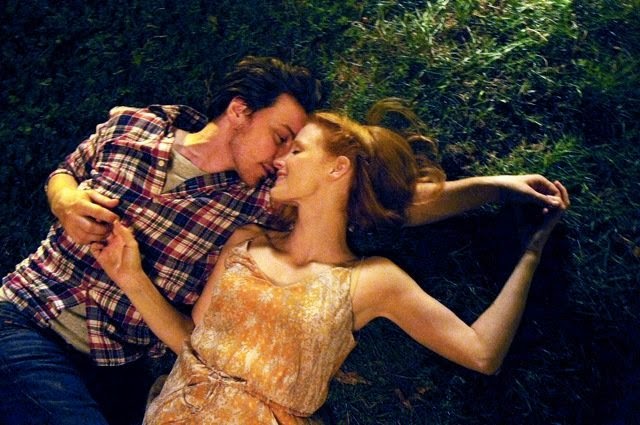
The film begins with a vignette of Conor and Eleanor at their youthful best; a playful bailing on a dinner bill followed by a nighttime park embrace amongst the fireflies that closely resembles a scene out of typical contemporary romantic flick. In one small cut, however, we see Eleanor calmly ride her bike to a bridge and jump off. She survives, but moves back in with her parents and avoids all contact with her husband.

Though what happened to bring the couple to this point is unveiled slowly, ultimately, their different methods of coping with tragedy have caused them to grow apart. While McAvoy is steady as Conor, and while the “Them” cut spends about the same amount of time on both of the relationship’s perspectives, the film still feels very much like the Jessica Chastain show. She has been masterful as both meek and powerful women (“The Help’s” Celia and “Zero Dark Thirty’s” Maya, respectively) but this is Chastain’s first big shot at the middle ground. Sometimes strong, sometimes on the verge of breaking, Chastain covers the spectrum flawlessly and in the process, crafts a character that even in the shortened version of the film, seems whole despite admittedly not knowing herself.

In his first feature film, writer-director Ned Benson fearlessly tackles his subject matter. In other hands, the film might have become the standard romantic drama its trailer makes it out to be, but Benson is not afraid to go beyond that (even if he did ultimately have to bite the bullet and cut the film down). The camera often lingers on Conor and Eleanor much longer than one would expect. In those extra seconds, however, it manages to engage the characters on a much deeper level. The pace is at times slow to a fault and some audience members may indeed stir (which leads one to wonder if the extended cut of the film will feel like overkill), but in the end, it is all put to great emotional effect.

Along the way, the film also gets some heartfelt supporting work from the likes of Viola Davis, William Hurt and Isabelle Huppert. The score, moody and melodic, features new (and currently unreleased) tracks by post-rock and alternative hip hop artist Son Lux. Christopher Blauvelt’s cinematography is, above all else, understated. Often, we simply follow the character, seeing what they see as it passes them by, yet the film always maintains a soft beauty similar to that established in last year’s “Her” by cinematographer Hoyte Van Hoytema. All of these intangibles come together exquisitely in the film’s entrancing finale.

“The Disappearance of Eleanor Rigby: Them” is one of this year’s pleasant cinematic surprises. What could easily turn out done-to-death in the hands of a first-time director instead serves as an introduction to a talented new helmer to watch, a reaffirmation of a top actress and a fresh addition to the romance genre. (Grade: B+)

Art House Appraisal is back!

Greetings Cinephiles!

After a longer-than-expected hiatus, it is with great pleasure that I announce that Art House Appraisal is officially back and here to stay. Despite being off of the blogosphere for a while, I have been watching this year's films as religiously as ever, so expect many, many reviews and top lists to come. Also, as a special treat, I will be attending several huge events at the New York Film Festival in the coming weeks. First, next Saturday I will be attending the world premier of writer-director Paul Thomas Anderson's new film, "Inherent Vice." There has been a ton of mystery surrounding this one (a trailer likely will not drop until after the premier) so expect a review the very next day to give you all a chance to gauge my reaction to the film as soon as possible. I will also be attending a special version of the festival's "On Cinema" film talk sessions with Anderson himself the following day. The event will consist of discussion of clips selected by Anderson from films that have inspired him, so expect some exclusive content from that as well. Then, the following weekend I will be attending screenings of heavily anticipated upcoming films "Birdman or the Unexpected Virtue of Ignorance" by "21 Grams" helmer Alejandro González Iñárritu and "Foxcatcher" by Bennett Miller; reviews will follow! 

Once again, welcome back and looking forward to posting soon and often!

Saturday, December 21, 2013

"Her" is a Beautiful Exploration of Love and Technology

"Her," while unconventional in concept, is an incredibly intimate exploration of the modern human relationship.
It may sound like a bad joke to say that the most intimate sex scene of the cinematic year is between a man and his computer, but that is exactly the type of magic that Spike Jonze works in his new film, "Her."

The scene features nothing more than a black, existential screen and what you might imagine phone sex between a madly-in-love couple set apart by a great distance would sound like. Unfortunately for the lovers in this case, that distance can never be lessened.

Theodore Twombly (played by Joaquin Phoenix) is at a lonely crossroads in his life. His appearance is upbeat, consisting of high-waisted pants, brightly colored button downs, thick-rimmed glasses and a caterpillar mustache, yet there is sadness in his demeanor. For work, he writes beautiful, moving love letters for clients whose relationships he traces. Though his writing reveals his sweet soul, Theodore has little use for it in his own life. The nearing end of his marriage to a woman he grew up and "experienced everything with" has left him pessimistic about life. If he has already experienced everything with Catherine (Rooney Mara, who looks much better with eyebrows), he wonders, won't everything else from this point on be redundant? In reality, the relationship has been over for sometime. All that's left is the signing of the divorce papers; the validation of an end that Theodore is not yet ready to accept.

In a moment of spontaneity, Theodore purchases a new, highly advanced operation system. He assigns the system a female voice and soon enough she has given herself a name. "Samantha," (a revelatory Scarlett Johansson) is sweet, bright and witty, and strikes a nerve in Theodore. Though he remains stuck in the shadow of his past and is not interested in real women for anything more than bodily urges, Theodore's relationship with Samantha is as honest and free-flowing as it is confounding to him. She is constantly evolving and developing a deeper desire to want, feel and experience the world the way humans do, and he, a hopeless dreamer, is looking for new ways to view at the world. He finds just that in Samantha and the two soon find themselves so deeply taken with one another that they are able to make love through nothing more than their voices.

To tell much more of the plot would be to ruin Jonze's wonderfully unique love story. It is refreshing to see such an unconventional concept treated with the delicacy and skill it deserves. The script, also written by Jonze, is wholly original and often hilarious. It is peppered with social commentary on the impact of the new age of technology on human interaction in the not too distant future (the film maintains a healthy balance between sci-fi and actuality).

The film also effectively balances humor with pathos; there are many scenes that at one moment feel like something out of a lighter comedy, yet remain one shot away from major emotional revelation. One stand out features a surrogate body service for human-operating system relationships. After Samantha experiences some difficulties in her relationship with Theodore, she hires a young woman to act as her "body" while the two make love. At first funny, the scene quickly shifts to intensely awkward viewing when Theodore finds the experience too weird to go through with and then accidentally reveals reservations he has about the relationship.

Though the film briefly delves into metaphysical matters, they are largely used as metaphors for cycles of the modern relationship, Jonze's depiction of which is perhaps the most accurate and honest in a good long while; don't be surprised if any or many of the conversations between Theodore and Samantha heavily resemble ones you've had with a significant other. As a result, all of the joy and heartbreak are palpable.

If ever a voice were to be deserving of acting nominations, it would be Johansson's. The range she is able to cover merely through intonation is deeper than most actors' or actresses' on-screen range.

Phoenix, meanwhile, is as powerful as ever. Some have unfairly labeled him as a typecast flawed wanderer, but a comparison between this role and his previous in last year's "The Master" should serve as evidence against that. Freddie Quell is a flawed wanderer indeed, but he is a volatile, rude, often thoughtless damaged soul. In that role, it is Phoenix's intensity coupled with emotional range that brings the performance to into the realm of greatness. Theodore, on the other hand, is a thinking man. He is a skilled and poetic writer in addition to a polite and socially comfortable man; his flawed wandering is only a result of his ending marriage. The characters are similar on a very thin surface layer, but, in fact, are very different. Phoenix covers both flawlessly.

Amy Adams, who seemingly can do no wrong of late, has a small role as Theodore's longtime best friend and neighbor. Her screen time is brief, but she still remains impressive as a more subtly damaged counterpart to Theodore.

Also noteworthy in the film are the score, featuring songs by Arcade Fire (like Supersymmetry, which was written specifically for the film despite appearing on the band's most recent album), and the delicate cinematography by Hoyte van Hoytema, which effectively contributes to the ambiguous yet deeply felt mood of Theodore and Samantha's relationship.

At its core, "Her" is one of the most intimate and timely romances in many years. It asks many questions of its viewers, perhaps the broadest, yet most important of which is: what makes love? Considering how intimately crafted the chemistry between Theodore and Samantha is, it's hard to imagine that Jonze is far off from an answer. (Grade: A)

Thursday, December 12, 2013

End of Semester and Stories to Come Including My Top Films of the Year


While the semester here at Rowan University is coming to a close, my posting here certainly will not. In fact, I dare say that I will now be able to post more often without the work load of classes for winter break, and I have lots planned for the coming months. 

Spike Jonze's "Her" is my most anticipated film of the
remaining cinematic year. (Photo by Warner Bros. Pictures
and Annapurna Pictures)
Check back soon for reviews of other top contenders I have seen this year as I will finally have a chance to organize my thoughts on each film (some I've seen several times) and write them full, graded reviews. Once I manage to see the remaining contenders of the year (I am most excited for Spike Jonze's "Her" at the moment) I will compile a list of my top films of the year and why I picked them. To give you a sneak preview, at the moment, my top five stands at:
Over the course of this semester perhaps the most important thing I've learned is that, ironically enough, film is not a subject that lends itself well to visual storytelling. For web video this proved especially true, as without being able to use actual footage and/or images from the film I am covering, subject matter becomes scarce. 

Photos are a little better. While it is difficult to get pictures of actors and directors without a press pass, it is not impossible. You just have to be very proactive and forceful about it; I pushed my way through a crowd of fans to get a picture of Carey Mulligan and ordered tickets for the New York Film Festival's opening screening of "12 Years a Slave" months in advance in order to be able to attend the Q and A with its director (Steve McQueen) and stars. 

Audio was the best of the multimedia storytelling options for film and I found that although it is a specific subject, there are knowledgeable sources for it all over the place, such as film professors. Film journalism, while more subjective in nature than say, news reporting, is nonetheless greatly improved by talking to those who know a lot about it.  

Below are my top five posts of the semester (in no particular order). Take a look back at them and enjoy:

Roger Ebert: the Man Who Revolutionized Film Criticism


In his book, "The Great Movies," Roger Ebert explores what are, in his view, the 100 most essential cinematic works in history. The timeline above lists those 100 by release date, director and stars. (All information is via Imdb.com and all photos without attribution are by unknown photographers and are in the public domain)


In April of this year, the film universe was saddened by the passing of "the best-known film critic in America."

Roger Ebert was not only one of the industry's most well-known pundits, he was one of its very best. Whether it was breaking new ground in becoming the first film critic to win the Pulitzer Prize for Criticism or his infamous on air reviewing of films during which he would coin the now common place idiom "Two thumbs up," Ebert was able to do what few critics before him could: popularize film criticism.

In a way, what Ebert did for film criticism is similar to what director Steven Spielberg did for the movie industry with the marketing and release of his 1975 thriller "Jaws." In the film, Spielberg created a first of its kind: the high concept film, or a film of a simple premise that can be easily pitched in 25 words or less. "Jaws" went on to become the first film to gross over $100 million in rentals and effectively built the summer blockbuster secret to box office success we know today.

Ebert, on the other hand, brought the secret of mainstream success to those who write about film. Not long after he started his career as a film critic in 1967, Ebert was already gathering attention for his work. Pauline Kael, who is widely regarded as the most influential film critic of her generation (right before Ebert's), called Ebert's early columns "the best film criticism being done in American newspapers today" shortly after she first read them.

Soon, Ebert, on the heels of his successful start in the business, became a co-host on a weekly film review television show called "Sneak Previews." Though the show started out as a local production in Chicago, it was soon picked up by PBS and shown to audiences nationwide.

Over the years, the show continued to draw successful ratings even through a number of network and name changes. It arguably reached it's most well-known period as "Ebert & Roeper and the Movies" from 2000-2002 when Ebert's fellow Chicago Sun-Times columnist Richard Roeper joined him as co-host.

"I remember the show being a big hit right away," said Raritan Valley Community College film professor and Ebert acquaintance Mark Bezanson. "I think that the show reached a lot of people, not just because it was accessible physically on television, but because it was accessible on a critical level. A lot of film critics talk in a sort of pretentious code, and Ebert took all that and put it in people language so to speak."

"The 'two thumbs up' thing didn't hurt the appeal either," Bezanson added.

Roger Ebert is remembered as the most well-known film
critic in America. (Photo owned by Roger Ebert)

What set Ebert apart from other film critics, in addition to his television exposure, was the simplicity of his critical style. He utilized straightforward film rating techniques such as a four star system as opposed to the many other wider ranging systems used, like one-to-10 scales. He also invented and trademarked the "two thumbs up" phrase which rated a movies success based on whether it received thumbs up or down from Ebert. The phrase quickly garnered universal appeal as it gave many the opportunity to quickly decide whether or not to see a film.

"The 'two thumbs up' thing was a big help when my husband and I would try to plan a weekend trip to the movies without the kids," said film fan and mother of three Carol Paterno. "I love movies but I never really had time to figure out what was worth seeing when they were little. And Roger Ebert was normally right so it became a pretty reliable thing for us."

In addition to gaining the approval of general audiences, Ebert also became popular with film insiders, particularly those with a taste for experimental films not popular with mainstream audiences, because of his approval and openness to such films.

Though he did not like the idea of top 10 lists, one he submitted to the 2012 Sight & Sound poll of the greatest films of all time included both Stanley Kubrick's 1968 evolution epic, "2001: A Space Odyssey," and Terrence Malick's 2010 wide-scaling life meditation, "The Tree of Life." The two films are examples of art house features with cult followings from both past and present eras and, upon release, each had just about as many detractors as they did admirers. Ebert praised them as two of the greatest of all time, however, in what was his signature "relative, not absolute" style of reviewing.

Interestingly enough, the beginning of Ebert's popularization of film criticism came in the same year that Spielberg reinvented the box office equation. Ebert first started as a television co-host in 1975, the same year "Jaws" was released. Ebert said of the film: "There are no doubt supposed to be all sorts of levels of meanings in such an archetypal story, but Spielberg wisely decides not to underline any of them. This is an action film content to stay entirely within the perimeters of its story." He knew how the film would revolutionize the business; he was in the process of doing the same to his own.

Saturday, December 7, 2013

The Rise of Writer-Director Paul Thomas Anderson

(Photo by Jürgen Fauth)
When any contemporary director is compared to the likes of Stanley Kubrick and Orson Welles, you take notice. No one in recent years has drawn more comparisons to the great auteurs than former film wunderkind and current American heavyweight Paul Thomas Anderson. From box office hits like 1997's unique look into the 70's porn industry, "Boogie Nights," to more experimental art-house efforts like 2012's "The Master," to sprawling epics like 2007's "There Will Be Blood," Anderson has already proven himself one of the most talented and versatile directors in the world today. Here is a look at how Anderson has risen to such heights just six films into his career:

Tuesday, December 3, 2013

"Prisoners" is a Skillfully Woven Maze in Search of an Ending


Hugh Jackman's intensity in "Prisoners" is something to behold.
Canada is slowly becoming a hotbed for compelling contemporary cinema. With time-hardened directors like James Cameron (“Avatar”) and David Chronenberg (“Eastern Promises”) still working their magic in addition to up-and-coming talent like Sarah Polley (“Away From Her”) producing increasingly interesting films, Canada’s stock is very much on the rise. Canadian director Denis Villeneuve proved himself an emphatic part of that field in 2010 with his highly touted family drama “Incendies,” and his latest film, “Prisoners,” continues his streak.

The film opens with a shot of a deer grazing through snowy woods. As the camera creeps backwards the tip of a shotgun comes into view, a prayer is whispered and the deer is slain. Here, innocence is overtaken by the crueler workings of the world, a sign of things to come for the hunters, Keller Dover (Hugh Jackman) and his son, Ralph.

Dover, his wife Grace and his two children, teenage Ralph and six-year-old Anna are visiting their neighbors for Thanksgiving dinner. Franklin and Nancy Birch (Terrence Howard and Viola Davis) have two children as well, teenage Eliza and six-year-old Joy. While taking their younger sisters on a walk, Ralph and Eliza spot an unfamiliar RV parked on a nearby street. The two stop their sisters from playing on it, and take them back. Soon after returning to the Birch residence, Anna and Joy ask to walk back over to the Dover household to look for a red whistle Anna was given by her father. It is lost, and so too become the little girls. When the two little girls go missing, the disappearance of the strange RV becomes the focus of the two panicking families.

Enter Alex Jones (Paul Dano). As the owner of the RV, Jones very quickly becomes the prime suspect in the kidnapping. It does not help his case that although tall and lanky, he is dressed like a 10-year old, has a far off look in his eyes and speaks in high-pitched, broken sentences. Despite being taken into custody, no evidence of any kind is found on Jones or his RV, and he is soon released to the care of his aunt and guardian, Holly (an almost unrecognizable Melissa Leo). Outraged by the police’s handling of the case, particularly a broken promise to keep the suspect in custody by Detective Loki (Jake Gyllenhaal), and vehemently certain that Jones is guilty and knows the whereabouts of the girls, Dover takes it upon himself to move the case forward and subsequently kidnaps the suspect.

Dover brings Jones to a boarded up and abandoned house in a presumably quiet part of town and begins to attempt to beat the whereabouts of the girls out of him. Jones says nothing, so Dover is forced to call upon both Franklin and Nancy for help.

Here, the film asks serious moral questions of its audience. Franklin is horrified by Dover’s actions. He knows it’s not right, yet at the same time there is the pull of the clock ticking on his chances of ever seeing his daughter again. How far are you willing to go to save a loved one? Should you be willing to go that far? Is it acceptable under these circumstances, or any for that matter?

“In the maze,” Jones tells Dover between scalding showers in a wooden cell. “That’s where you’ll find them.”

Dover has no idea what this means, of course, but “the maze” is a recurring symbol throughout the film and also effectively serves as a metaphor for each characters struggle; each is trapped in a seemingly inescapable maze. Franklin and Nancy are trapped between their guilt in allowing Dover to brutalize Jones and their desire to save their daughter; Jones is trapped in both the physical confines of Dover’s torture and his own mental confines, as there is very obviously something preventing him from telling what he knows; Anna and Joy are trapped in the hands on their abductor; Dover is trapped between the desperation to find his daughter and the growing likelihood that he will not be around to provide for her (should he find her) once the police discover what he is doing with Jones. Each character is a “prisoner” to his or her own maze.

Though the storyline asks compelling questions of its viewers, it is its haunting cinematography and score that lift it to its highest points. Academy Award nominated cinematographer Roger Deakins (“The Shawshank Redemption,” “No Country for Old Men”) instills a constant sense of dread and filth throughout the film with his often jarring, yet always visually compelling camera work. Jóhann Jóhannsson’s original score, meanwhile, shows deep range; from slowly building the suspense and dread involved in the mystery of it all to the emotional weight the events take on those involved, Jóhannsson covers it flawlessly.

Another driving force of the film is its intensity. Jackman’s performance comes to the forefront for sheer explosiveness and effective transparency; his eruptions are not of ultimate assurance, but rather a lack thereof he is compensating for. The performance of Gyllenhaal as Detective Loki, while not as forthcoming as Jackman’s, is nonetheless a major part of the foundation of the film’s sense of dread. He has a facial tick that grows more and more prominent as tension builds in the plot. He is implosive, appearing calm and collected throughout, his deterioration only noticeable through the slightest of details until he finally explodes in one of the more compelling set pieces of recent years.

Where this film loses steam, however, is in its latter half. While suspense built is constantly rewarded with real results throughout the first half of the film, it is repeatedly left empty as the film nears its conclusion, which turns out to be its weakest point. There is a very distinct difference between an effectively ambiguous ending and a non-ending. “Prisoners,” unfortunately, for all its ambition, features the latter.

Perhaps more so than any other film in recent years, "Prisoners" is a half film. Er, about three-quarters of a film to be more specific. It is almost as if Villeneuve got injured and sat out the fourth quarter, leaving a substitute to try to bring home the win. Though there is much to appreciate in "Prisoners," the fourth quarter is crunch-time and taking it off does not lead to victory. (Grade: C+)

Monday, December 2, 2013

“12 Years a Slave” is a Brutal Masterpiece

Michael Fassbender (left), Lupita Nyong'o (center) and Chiwetel Ejiofor (right) turn in performances as relentless as Steve McQueen's direction in "12 Years a Slave."
Acclaimed director Steve McQueen’s new film “12 Years a Slave” has been widely talked about as a front-runner for the Academy Award for Best Picture since its premier at the Telluride Film Festival and subsequent screenings at the Toronto International Film Festival. Some, like Kyle Buchanan of Vulture Magazine, have even gone as far as saying that it has already won the award.

Believe the hype.
            
McQueen is one of the most talented directors in the world at the moment. Unrelenting and brutal in his craft, his previous film, “Shame” (2011), an experimental character study about sex addiction, though critically acclaimed, was ignored by the academy largely due to its controversial subject matter. “12 Years a Slave” will not have the same problem.

The film, though brutal, features an incredible true story of significant historical importance. It dramatizes the autobiography of the same name by Solomon Northup, a free black man who was kidnapped and sold into slavery in 1941. Northup, brilliantly played by Chiwetel Ejiofor (“Children of Men”) in a breakout role of sorts, witnesses and endures the unspeakable cruelty of slavery. 

True to his honest style of filmmaking, McQueen seems set on exposing slavery in the antebellum South exactly as it was with no violent detail withheld. He remains at a distance, not judging any of his characters but rather letting their actions speak for them.

When first tricked and kidnapped, Northup is savagely whipped for insisting that he is a free man. Most contemporary directors would construct this scene with one quick cut into the action of the abuse and move on. McQueen lets the camera linger uncut for several minutes while Northup is whipped over and over again. The violence is not highly stylized like it would be in a Quentin Tarantino film; it is simply unequivocal. Needless to say, this film is not for the faint of heart.

During the initial whipping scene, Northup’s captor repeatedly calls for him to admit he is a slave. But Northup refuses to give in to his injustice, and though his persistence continually results in unfathomable cruelty on Louisiana plantations, he holds hope that he will one day see his wife and two kids again.

The fact that the story is true is combined with McQueen’s uncompromising direction makes the film an incredibly powerful experience. It’s acting, however, takes it to an entirely different level. Ejiofor’s depiction of Northup is the stuff of legends and should set him as an absolute lock for a best actor nomination. Mark him down as one to watch. Michael Fassbender (in his third collaboration with McQueen) is also a force as the most evil of Northup’s slave owners, Edwin Epps, and the supporting cast featuring the likes of Paul Dano (“Little Miss Sunshine”) and Sarah Paulson (“Mud”) all turn in compelling performances.

The biggest surprise of the film is undoubtedly the performance of Lupita Nyong’o in her American film debut. Nyong’o plays Patsey, a slave so badly abused that she becomes suicidal. Her ability to simply handle the sheer emotional weight of her role in a debut is amazing in itself, but she masters it. Like Ejiofor, she is one to look out for.

All of this is more than enough to make a great film. But “12 Years a Slave” packs yet another punch: the absolute centerpiece of the year. In the scene, Northup is forced by Epps to whip fellow slave Patsey, who he has grown close to. It is shot in one continuous take and lasts for over 5 minutes. The camera weaves in and out of the action, shifting with the ebbs and flows of the scene. Dialogue gives way to a heart-wrenching score by famed composer Hans Zimmer (“Rain Man,” “Gladiator”). Characters are broken; humanity questioned. One must simply see the shot in order to experience its power and horror.

The film's negatives really all boil down to taste. Those with weak stomachs will not like it. Those who prefer light and entertaining films will probably not like it either. Fans of intimately detailed dramas and historical epics will love it, however. Tonally the film is much like McQueen’s first feature, “Hunger,” a dramatization of the prison experience and hunger strike of Irish Republican Army protestor Bobby Sand’s (played by Fassbender) in 1981. A steady, controlled pace accentuates the shocking content displayed in each. Both films are based on true historical accounts and while “12 Years a Slave” may resonate with audiences as a tale of a more horrifying injustice, they are very similarly crafted.

Though the acts depicted are despicable and often hard to watch, it is hard not to be compelled by the film’s historical weight. “12 Years a Slave” is important because it strives to depict uncensored truth, and all of its intangibles make it perhaps the first great film of the decade. (Grade: A+)

Saturday, November 9, 2013

Reel Rant: Greatest Injustices of the Past Several Years of Academy Awards

It's that time of year again: awards season. Each ceremony brings different opinions and lots of surprises, some good and some bad. The season's culminating ceremony, however, is also its most predictable. That the Academy Awards are traditionally previewed with articles that split "what should win" and "what will win" into separate categories is telling of what is usually to come: they're going to get it wrong. For fans of experimental, art house and even independent cinema, there is very little to enjoy in watching the highest profile middlebrow film of the year hailed as the "best picture." In fact, anyone who enjoys cinema of controversial nature of any kind will likely be disappointed by the Oscars. While it is going to be difficult for the panel to ignore what I, in my humble opinion, believe to be the best picture of the year so far in director Steve McQueen's masterful "12 Years a Slave" (although it is still very early in the race with many contenders still to come), I've learned to expect nothing. In honor of the upcoming awards season, here are the greatest injustices of the Academy Awards of the past several years:

2012: 

Paul Thomas Anderson's "The Master" was largely
ignored by the Academy. (Photo by Jürgen Fauth)
The 85th Academy Awards Ceremony was undoubtedly one of the worst in recent memory; it would be easier to list what the panel actually got right. The biggest injustices came in the four major categories, however. Let me start with Best Picture. It was difficult to take this race seriously from the time the nominees were announced because the film I believe was and is the best of 2012, Paul Thomas Anderson's "The Master," was left out. The film is experimental to say the least and certainly has its detractors, but there is no one world making more compelling cinema at the moment than Anderson, and explosive, powerfully acted scenes like a jail room confrontation between Joaquin Phoenix's Freddie Quell and Philip Seymour Hoffman's Lancaster Dodd lift "The Master" above anything else in 2012. For me, Michael Haneke's heart-wrenching "Amour" is a close second, and as it was nominated for the award, I naturally felt it deserved the win. Instead, the award was given to the suspenseful but ultimately safe "Argo" by Ben Affleck.

Best Actor was equally as disappointing. Many consider Daniel Day-Lewis to be the greatest actor in the world today, something I believe to be true. His portrayal of Abraham Lincoln is transformative, but 2012 should have been the year of the return of Joaquin Phoenix. Credit to the Academy for nominating him in spite of a high profile interview in which he called the ceremony "bullshit," but a completely unbiased panel would have rightfully given him the award. His performance in "The Master" is the stuff of legends; it is very reminiscent of a young Marlon Brando, both in range and commitment. Day-Lewis's Abraham Lincoln is flawlessly executed, but Phoenix's Freddie Quell is far more compelling and the psychological commitment far deeper. Day-Lewis's win was expected by most, but not rightfully so.

Jennifer Lawrence is one of the most talented young actresses in the world today and it is damn near impossible not to love her persona, but to be perfectly frank, I would have been satisfied with any of her competitors winning Best Actress, just not her. This was a close race to be sure. Jessica Chastain's Maya was a revelation and the driving force of "Zero Dark Thirty," Emmanuel Riva's Anne effectively broke hearts and records in "Amour" (the oldest ever nominee for the award), Quvenzhane Wallis's Hushpuppy was powerful enough to deserve a win without the feel-good story bias involved in her age and even though Naomi Watts's role as Maria Bennett in tsunami tear-jerker "The Impossible" was brief, she handled the considerable physicality of the role with grace. Lawrence was the middlebrow choice of the pack, so of course, the panel handed her the award. In truth, while nothing was wrong with her performance as Tiffany, there was nothing truly captivating about it; all four of her competitors were, in one way or another, thoroughly compelling.

I'm not sure where the Academy was going with their choice in nominees for Best Director. No Paul Thomas Anderson? No Kathryn Bigelow? The race was not legitimate from the start, and like Best Picture, the deserving nominee, Haneke, was not awarded.

Just a notably bad year in a collection of bad years for the Oscars.

2011:

Michael Shannon's career-best performance in "Take Shelter"
was snubbed by the Academy. (Photo by Flickr user Nicogenin)
Another year in which the four major categories just flat out stunk. I have an unconventional pick for best film of the year, and I fully understand that many may not share this point of view, but the best thing I saw in 2011 was Jeff Nichol's "Take Shelter." Yes, it is a lower budget independent feature, but the output is all that should matter, and there was nothing else in 2011 quite like the psychological punch of "Take Shelter." Not to give it Best Picture is one thing, but no nomination? Good old Academy. Likewise, no nomination for Michael Shannon in the film's lead role was an atrocity. While I don't like the absence of the movie in the Best Picture line up, I expected it. This was unexpected and wrong. One would be hard-pressed to find a greater level of intensity in a performance than Shannon's.

As for those actually nominated, Terrence Malick's beautiful and ambiguous "The Tree of Life" deserved the win, and in history will be considered the cinematic achievement of 2011. Then there's "The Artist," perhaps the most middlebrow nominee of the past decade. There is nothing special about it (in fact, I find it to be flat out boring and grossly overrated). Even if you didn't watch the ceremony, you could have guessed which one the Academy would chose. "The Artist" also won Best Director (Michel Hazanavicius) and Best Actor (Jean Dujardin); it did not deserve either. 

Best Actress was the only category not plagued by an "Artist" nominee, yet the panel found a way to stink it up anyway. Kirsten Dunst gave the best performance of the year (as well as her career) as Justine in Lars von Trier's "Melancholia" (which was also wrongly ignored for Best Picture and/or Director), but of course, she was not nominated. In what was otherwise a somewhat barren year for actress nominees, I felt that Michelle Williams did enough as Marilyn Monroe in "My Week with Marilyn" to deserve the award. But the great Meryl Streep was also nominated. She's an all-time great, but her turn as Margaret Thatcher in "The Iron Lady" is not one of her best performances. In this case, she won the award not based on merit, but because of her reputation. 

2010: 

This year wasn't as bad as 2011 or 2012, but still the major awards were safe as can be. I see "127 Hours" as the best film of 2010 based on a virtuoso performance from James Franco and the fact that there has seldom been a film so inspiring in history. This is likely to be viewed as another unconventional pick in the eyes of many, but since when has "conventionality" been a defining quality of great cinema? Anyway, 2010's Best Picture winner, "The King's Speech," is solid, but not the best film of the year. If not "127 Hours," I would have liked to see Darren Aronofsky's "Black Swan" take home Best Picture and Best Director. "The King's Speech" got both. It also got Best Actor (Colin Firth). Let's be real: watch Franco cut his own arm off and then watch Firth simply stutter away for two hours and you tell me whose performance was more compelling.

2007:

Both "There Will Be Blood" and "No Country for Old Men" were shot in
Marfa, Texas at the same time. (Photo by Flickr user Movie Stars and Rockets)
I'm skipping 2008 and 2009 because there was nothing I felt strongly enough about to consider an injustice those years. 2007, however, is the home of, in my eyes, the biggest Academy Award injustice of the past several decades.  Paul Thomas Anderson's "There Will Be Blood" is the best film of the past 10 years. That is probably the most steadfast opinion I hold in contemporary cinema. "There Will Be Blood" features the greatest performance in the career of the greatest actor of this generation (Day-Lewis), an incredibly interesting and creatively adapted screenplay by Anderson, one of the most effective minimalist scores I've ever heard by Radio Head's Jonny Greenwood and countless other flawlessly executed cinematic intangibles. It is the reason Anderson is my favorite contemporary director.

2007 was a landmark year in cinema; it's not common that two all-time great films are released in the same year, but that is exactly what happened with Joel and Ethan Coen's "No Country for Old Men" and "There Will Be Blood" (interestingly enough, the two were shot within miles of one another in Marfa, Texas at the same time and smoke from the set of "There Will Be Blood" interfered with a day of shooting for the Coens). Both are great, but "There Will Be Blood" is greater. As a result, it should have taken both Best Picture and Best Director. "No Country" took both, however, and in any other year it would have been well-deserved. But not 2007.

Saturday, November 2, 2013

Rowan Film Professor and Author Dr. Sheri Chinen Biesen on Film vs. Digital and Streaming

Dr. Sheri Chinen Biesen's book, Black Out,
focuses on her specialty, film noir.
(Photo by Josh Hopkins University Press)
Dr. Sheri Chinen Biesen is a film professor at Rowan University and the author of Black Out: World War II and the Origins of Film Noir. She teaches classes like American film directors and film history, but her favorite is her specialty, film noir. As a film historian, Biesen has a trained eye. She can spot a bad print as soon as it graces a screen, and the overexposure that often comes with film restoration makes her cringe. To her, there's nothing like the look and feel of a pristine 35 millimeter print on the big screen. I spoke with her this week about the ongoing film vs. digital debate and although she is understandably critical of the use of digital projection, I found her surprisingly open to new methods of distribution like streaming. Listen to what she had to say here:

Tuesday, October 29, 2013

Shots: Lars von Trier's "Melancholia"

This is an introduction to a new type of post for the site, "Shots." Each "Shots" post will focus on important images in a specific film. While re watching a film (I will not do a "shots" post for a film on my first viewing, as I need to be familiar with it in order to pick and choose what images are important) I will pause, bring up relevant subtitles and screen shot images that are crucial to the film as a cinematic work of art. After narrowing down the many "shots" of the film, I will put them together in a photo gallery. Enjoy and engage!

"Melancholia" is one of the more beautifully photographed films of the past few years, so naturally it was an easy first choice for the series. Released in 2011 and directed by Lars von Trier, the film is a portrait of depression. It parallels the depressed with the mentally stable and then adds in a coming disaster to test the sides. Justine (Kirsten Dunst) plays the depressed here, while her sister Claire (Charlotte Gainsbourg) is, in a general sense, normal. The film follows the pair through Justine's wedding night and the coming of a planet on a possible collision course with Earth.

Here are the images of "Melancholia":

Saturday, October 19, 2013

In Honor of the Upcoming Release of "Nymphomaniac," the Top Five Films of Director Lars Von Trier

Lars von Trier has earned a reputation as one of the best
and most controversial directors in contemporary cinema.
(Photo by Georges Biard)
With polarizing Danish director Lars von Trier's new film, "Nymphomaniac," set for a Christmas release, hype has been steadily building over the past few months. It began when the director announced that the film will be an introduction to a new genre of film, digressionism.  The two part film, which seems set to be on par with the ballsy director's most controversial as it will feature unsimulated sex (something star Shia LaBeouf claims to be absolutely for real), has been promoted through a slow release of content to the public. Every month the film's official website has been releasing a new short clip to introduce the chapters of the film, each ambiguous and more suggestive than the last. Recent releases have also included a set of risqué promo photos. In honor of von Trier's latest exploits, here is my list of the director's top five films:

5. "Europa" (1991) - The third and final film of von Trier's first trilogy also serves as the final film before his style transformation. This is not to say that the film veers that far away from typical von Trier traits; it is experimental, surrealistic and above all else, dark (some critics have noted that the film imitates many film-noir conventions), all things that scream von Trier. However, the director's next film, "Breaking the Waves," saw a switch to almost entirely handheld and grainy camera work broken up with highly stylized still shots, something that would become a trademark of a von Trier film in his later work. In that respect, "Europa" is a much more formalistic von Trier. It is beautifully shot in black and white with an occasional burst of color (sometimes both within the same shot) and tells the story of an obliviously idealistic American (Jean-Marc Barr) who sets off to work as a train conductor in post World War II U.S.-occupied Germany. He falls for a femme fatale (Barbara Sukowa) and soon finds himself in the middle of a terrorist conspiracy. Though it is not typical von Trier as film fans have come to know him, "Europa" remains one of his best.

4. "Antichrist" (2009) - No film in von Trier's bad-boy repertoire has created more controversy than "Antichrist." The film's premier at the 2009 Cannes Film Festical saw at least four people faint due to its explicit content and von Trier was even asked by a journalist to justify bringing the film to Cannes, to which he famously replied that he considered the audience to be his guests and that he did not need to justify the film. The reason for the outcry is obvious: the film features graphic sex, uncensored self-mutilation and thematic elements that have been viewed by some as antifeminist. Some scenes of the film are, in fact, extremely hard to watch. Yet there are many aspects of the film that are too intriguing for serious film fans to ignore. In fact, for all of its high profile negative response, critical reception of the film has been just about split down the middle. It's opening scene, one of von Trier's steadily shot montages, is among the more beautiful of his career. It is shot in black and white slow motion with a very deep focus and features a couple (Charlotte Gainsbourg and Willem Dafou) having what appears to be passionate sex. At the same time, the couple's child, a young baby, climbs out of a window and falls to his death. All of this is set to the exquisite "Lascia ch'io pianga" by George Frideric Handel. The scene is both shocking and beautiful, which is a good indication of what is to come. The rest of the narrative deals with the couple's attempts to stem grief resulting from the death of their son, and as they retreat to a cabin in the woods, madness prevails. For all of its naysayers, and as hard as it is to watch, scenes of stunning beauty make "Antichrist" a must-see for von Trier fans.

3. "Melancholia" (2011) - Von Trier has admittedly suffered from depression over the years (he wrote "Antichrist" during one of his all-time lows) and in 2011, he took to his profession to attack his affliction head-on. In "Melancholia" one gets the feeling that what they are being shown is beyond research; it's the type of thing one must know first hand. Coming from an experimental director like von Trier, this is not exactly as it sounds, but there is a pervading authenticity throughout the film. "Melancholia" tells three interwoven stories split into two chapters. The first is that of Justine (a brilliant Kirsten Dunst in her best performance to date), a sufferer of chronic depression who is attempting to get married and lead a normal life. The second story belongs to Claire (Charlotte Gainsbourg), Justine's sister who cares for her during her depression episodes, and the third is the impending end of the world at the hands of a rogue planet named Melancholia that is predicted by scientists to be on a collision course with Earth. Von Trier uses this premise to explore the parallels of depression and everyday life. In the real world, the depressed cannot function, but in the face of a disaster, roles are reversed. "Melancholia" features gorgeous cinematography, daring performances and a powerful vision of depression and destruction.

2. "Dancer in the Dark" (2000) - Every experimental director has at least one film that is grossly overlooked, and this is von Trier's. What "Dancer in the Dark" should be viewed as is an absolute confirmation of von Trier as an actor's director, and one of the most unlikely in film history at that. On paper his style should take attention away from performances and place it instead on the making of his films, yet time and again he draws spectacular performances from his stars. Notably, these performances are never replicated again by the stars. The first and most notable of these performances is his shaping of Emily Watson's Bess in "Breaking the Waves"; although Watson has had a couple of compelling performances since ("Hilary and Jackie" among others), nothing comes close to her acting debut with von Trier. In "Dancer in the Dark," von Trier provokes an absolutely heart-wrenching and scarily authentic performance from Icelandic singer Björk, who had only previously appeared in one film. Björk plays Selma, a Czech immigrant who has come to the United States with her son, Gene, and is struggling to make ends meet with a factory job and very poor eye sight. Selma is the embodiment of innocence (the film is the third and final addition to von Trier's "Golden Heart Trilogy," which focuses on innocence wronged) and as she is continually taken advantage of, von Trier simultaneously plays with your heart-strings. The film's ending is, typical of all great von Trier scenes, both haunting and beautiful. It's a shame that what this film shows of von Trier's ability to draw pure performances from his leads was not truly recognized until what he drew from Kirsten Dunst in "Melancholia" because it takes notoriety away from what is an all-time great film. Björk was so emotionally drained from the role that upon completion of the film, she claimed she would never act again, which makes sense, as this is the type of performance actors and actresses often leave a part of themselves in. Experimental as always, von Trier uses a compelling combination of musical numbers and drama to achieve his final product, but it is what he forces out of his star that makes "Dancer in the Dark" a special film.

1. "Breaking the Waves" (1996) - This is, and likely always will be, considered von Trier's masterpiece. It was the introduction to audiences of what would become his signature style of filmmaking, and interestingly enough, he has never been more masterful in applying it to his craft. "Breaking the Waves," the first of von Trier's "Golden Heart Trilogy," tells the story of the dangers of rigidity in religion. The "Golden Heart" of the tale is Bess McNeill (Emily Watson), a young Scottish woman of childishly idealistic ideas about love and religion. She talks to God about every move she makes, and believes in his influence on her life to a fault. This is the result of the extremely traditional religious environment she has been brought up in. When her new husband, Jan (Stellan Skarsgard), gets paralyzed while working on an oil rig after Bess had prayed to God to "send him home," she is convinced that his injury is her fault. She sets about keeping him alive in what turns out to be one of the saddest, most degrading displays of purity and innocence  in film history. Von Trier uses handheld camera work strategically to subconsciously attach viewers to the ingenuous Bess, making for an emotional tour de force. Watson is absolutely spectacular in her acting debut and the story is timeless. Though perhaps less experimental than von Trier's most notorious works, it is every bit as powerful and then some. "Breaking the Waves" is no easy ride, but no von Trier film is, and the director puts all of his pieces together in such compelling fashion that it would be wrong to call it any less than a masterpiece.