Pages

Showing posts with label film reviews. Show all posts

Wednesday, November 12, 2014

Steve Carell and Channing Tatum Excel Like Never Before in Quiet and Physical "Foxcatcher"

(Photos by Michael Iannucci)
Though stars Steve Carell and Channing Tatum have shown glimpses of serious acting chops throughout their careers (Carell’s most notably coming in 2006’s Little Miss Sunshine and Tatum’s in 2012’s Magic Mike), those have been few and far between until now. The two have, for the most part, stuck to lighter, somewhat silly films (sometimes intentionally, sometimes not), but director Bennett Miller’s “Foxcatcher” is anything but that.

The film is based on the true story of Olympic wrestling champion brothers Mark (Tatum) and Dave (Mark Ruffalo) Schultz and their path to the 1988 Seoul Olympic Games after eccentric millionaire John du Pont (Carell) becomes personally invested in their careers. Following his 1984 gold medal win, Mark lives a solitary life consisting of little more than training with his brother, who is already a settled family man, and occasionally speaking at schools for some much needed cash. Quiet and brooding, he is clearly unsatisfied with his current situation. As he goes about his everyday life, arms wide and shoulders tense, only speaking when spoken to, he resembles a caged animal and in his interactions with Dave, he is the baby brother wanting to step out of Dave’s more celebrated shadow. 

After being mysteriously called upon to visit the home of du Pont and learning that the philanthropist wants to sponsor Mark’s career, Mark is boyishly elated. He moves out to du Pont’s estate to train, where he becomes a member of “Team Foxcatcher” (the name of the horse racing stable du Pont’s father once kept). The two develop a close father-son relationship, but it is eventually interrupted when du Pont convinces Dave to move his family and join them.

There is a pervading quietness to the film that gives way to a sense of dread. Scenes go by with very few words being spoken, yet the intensity is always such that an explosion seems imminent. This is in part owed to the understated direction by Miller, who has thrived on presenting biographical stories in a hushed tone, just as he did in his previous two films, “Capote” (2005) and “Moneyball” (2011). Carell’s creepy du Pont and Tatum’s physically explosive Mark are center of the atmosphere, however. Du Pont’s exaggerated prosthetic nose, pompous yet insecure gait and slow speaking pattern highlight a man whose own ridiculous behavior is hiding serious mental instability. Though he is physically present, his mind is far off screen. Mark, meanwhile, is a squarish muscle mass who hides behind a scowl until he is driven to physical combustion. When the two are on screen together, the tension is incredible.

Despite the film being a wholly serious endeavor, there are moments that are darkly funny. Du Pont’s relationship with his mother (Vanessa Redgrave), who turns out to be a major figure looming behind du Pont’s mental unsteadiness, brings an occasional uneasy laugh. So too does his self-obsession, which borders on the pathetic. His friends call him “golden eagle,” or so he says.

While the film’s quiet nature is a part of what makes its physicality all the more powerful, it is, at times, too quiet for its own good. The film loses a bit of its steam in its final act, but one conclusive explosion in that same act is compelling enough to redeem the slow moments.
  
Although Ruffalo often plays referee to the Carell and Tatum show, his performance would be towering in many other films and is the best from the actor in quite some time. Tatum’s performance on the wrestling mat is also something to behold; much like Natalie Portman’s dazzling performance as a ballet dancer in 2010’s “Black Swan,” Tatum appears to have mastered the craft of the mat in preparation for the role he called “the hardest acting challenge I’ve had to date.”

Overall, “Foxcatcher” is an emotionally distant, yet powerful biographical drama about troubled men who speak little of what they feel but can do little to hide it in their often-volatile actions. In that setting, performances inevitably come to the forefront, and given the chance, Carell and Tatum shine like never before. (Grade: B+)

Foxcatcher comes out Friday, November 14 in select theaters

Wednesday, October 8, 2014

Paul Thomas Anderson's "Inherent Vice" is a Visceral Experience, Even If It Does Confuse

(Photos courtesy of Warner Bros/NYFF)
Paul Thomas Anderson’s new film, “Inherent Vice,” asks an important question of its viewers: Where does a coherent plot factor into what makes a movie “good” or “bad?” If you place heavy importance on plot, then you will likely leave the film extremely frustrated. If you tend to rely on the feel of a film rather than specifically what is going on and why, however, then you will find it a hypnotic experience unlike anything else in cinema. 

It comes as no great surprise that the film’s helmer himself is an advocate of the latter contention. At his “On Cinema” masterclass at the New York Film Festival, where “Inherent Vice” premiered to mixed reviews this past weekend, Anderson stated: “I never remember plots in movies. I remember how they make me feel. I remember emotions and I remember visual things that I’ve seen and my brain has just never connected the dots of how things go together.” This almost seems to be an indirect response to the early criticism of his film, which almost entirely centered on its confusing plot. While it is certainly reasonable to be put off by a movie that (so far) seems to universally confuse, there is far too much else to “Inherent Vice” to simply write it off.

The film follows Doc Sportello, an often-stoned hippie private eye with long greasy locks and prominent mutton chops (played by a typically excellent Joaquin Phoenix), as he tries to appease ex-girlfriend Shasta (exciting newcomer Katherine Waterston) by investigating the disappearance of her new lover. Set in a drugged out ‘70’s Los Angeles with a hazy noir feel, Doc must weave his way through a maze of characters ranging from a saxophone player turned undercover cop (Owen Wilson) to a cocaine addict dentist (Martin Short), who is not above corrupting a young blonde patient of his, in order to find out just what the heck is actually going on.

The rest of the ensemble cast includes Josh Brolin, who plays Bigfoot, a hippie-hating cop who harasses Doc every chance he gets, Benicio Del Toro, Reese Witherspoon, Maya Rudolph, Jena Malone, and musician Joanna Newsom, who narrates the film. While the plot can at times be even more confusing than it sounds, perplexity is actually a part of this film’s charm, something it owes to its source material, the novel of the same name by famously reclusive novelist Thomas Pynchon. This marks the first time that Pynchon has allowed one of his novels to be adapted to the big screen, and according to his readers, the chaotic nature of the film can be directly traced back to the novel.

“It was a bit episodic and there was a sort of jumping from stone to stone to stone and sometimes these connected pieces were made in the book, sometimes they weren’t. There were various blind alleys and dead end streets,” said Anderson of adapting the novel.

Indeed, the film has a rapid pace and often the viewer is introduced to characters and situations that quickly disappear and end up having no real bearing in anything. That’s life; everything is not going to directly tie into everything else. In the detective field, that must be dealt with regularly. In that way, “Inherent Vice” honors realism, but it is really its surrealism that is eye catching.

In the lead up to the film’s first viewings, most expected Anderson to return to his “Boogie Nights” roots. In other words, most expected a lighter and more formal ensemble comedy. Instead, the film is much closer to Anderson’s most recent film, “The Master,” in its look and feel. Throughout that film, there are moments that although apparently embedded in reality, feel surreal. An apparent dream that ends up having some bearing in actuality towards the end of the film comes to mind. The same can be said of many moments in “Inherent Vice,” such as an odd trip to a psychiatric hospital by Doc.

Despite all of its outrageous comedic elements, there is a brooding sadness just below the surface of “Inherent Vice”. Pynchon readers say this is also present in the novel. However, it is also a common theme in Anderson’s work. In “The Master,” beneath lead character Freddie Quell’s (also played by Phoenix) corrosive veneer, there is a very detectable sorrow. The same can be said of most Anderson protagonists, but “Inherent Vice’s” contrasting tone is highlighted by raw, often sensual camerawork and an eventual sense of self-discovery by the protagonist, just as it is in “The Master.” Also, at the heart of the two stories are a girl and the regret of love lost, both of which come to an explosive peak in an incredible long-take between Doc and Shasta in “Inherent Vice.”

It is interesting to note that Anderson has reteamed with cinematographer Robert Elswit for “Inherent Vice.” The two worked together for all of Anderson’s films except “The Master,” yet the look they create in this is closer to that film than any of their past collaborations.

Fans of Anderson will most certainly be pleased with all of this, but the film interestingly has the guns to keep general audiences satisfied as well despite its plot difficulties. The part deadpan, part outrageous stoner comedy script is hilarious. Look for the film to gain cult status among the same group that holds films like “The Big Lebowski” so high. Because of this, it should serve as a confirmation of Anderson as one of the most versatile directors in the world today. Also, the environment is so rich and expertly crafted that is will likely compel both those who lived through it and those who did not.

The score, another product of the Anderson-Jonny Greenwood marriage now in its third film, is fun and an effective match to its on-screen material. It features everything from Neil Young’s “Harvest” to original work by Greenwood. Performances of the actors are as compelling as one would expect from such a talented cast, particularly Phoenix and Waterston (although Brolin just might be a show stealer of sorts).

Overall, complaints of a confusing plot feel weak in comparison to all that “Inherent Vice” has going for it. Cinematic history is riddled with confusing films that have nonetheless been deemed masterpieces. Take “2001: A Space Odyssey,” for example. Widely considered to be lofty among the greats, the film is also considered to be one of the more confusing films in history. If someone could explain the entire plot beginning to end without theorizing, they’d be the first. So the question then becomes, if deeply serious films can become revered without an entirely discernible plot, then why can’t comedies? Especially one as beautifully crafted and spellbinding as “Inherent Vice.” (Grade: A-)

Sunday, September 28, 2014

"The Disappearance of Eleanor Rigby: Them" is an Original Debut for Writer-Director Ned Benson

"The Disappearance of Eleanor Rigby" was originally split into "Him" and "Her" perspective cuts before being combined into "Them" to shorten the film's running time. 
Jessica Chastain’s star seems to be ever rising, even if her pace has slowed a bit since 2011’s ridiculous seven-film burst into the spotlight.  With a resume already featuring Academy Award nominated performances for polar opposite roles in “The Help” and “Zero Dark Thirty,” the versatile American actress may have just turned in her most complete performance to date in “The Disappearance of Eleanor Rigby: Them.”

The film has an interesting back-story. Its original release came at last year’s Toronto International Film Festival where it ran a total of 191 minutes split between two different parts titled “Him” and “Her.” The two parts tell the same story of a married couple reeling in the wake of extreme tragedy, but “Him” is shown through the eyes of Conor (James McAvoy) while “Her” is shown through those of his wife, Eleanor (Chastain). The project was widely well received as an ambitious look at the different perspectives involved in a marriage in crisis, but its bladder-challenging running time made the prospects of a wide release tough. As a result of this, a third cut of the film was prepared entitled “Them,” featuring both perspectives fused into a commercial friendly 123 minutes. “Him” and “Her” are set to be released in select theaters in October nonetheless, but “Them” is currently screening in theaters nationwide.

It remains to be seen whether the reduced “Them” cut has lost anything significant in the editing room (and some who have seen both cuts have voiced that it has indeed), but “Them” remains a thoroughly compelling piece of cinema that treads waters few romances do.

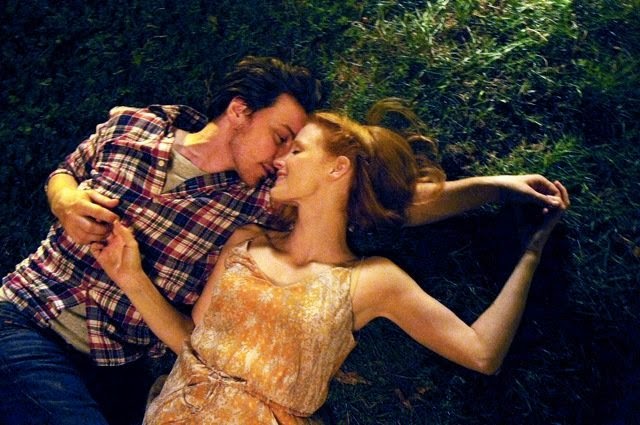
The film begins with a vignette of Conor and Eleanor at their youthful best; a playful bailing on a dinner bill followed by a nighttime park embrace amongst the fireflies that closely resembles a scene out of typical contemporary romantic flick. In one small cut, however, we see Eleanor calmly ride her bike to a bridge and jump off. She survives, but moves back in with her parents and avoids all contact with her husband.

Though what happened to bring the couple to this point is unveiled slowly, ultimately, their different methods of coping with tragedy have caused them to grow apart. While McAvoy is steady as Conor, and while the “Them” cut spends about the same amount of time on both of the relationship’s perspectives, the film still feels very much like the Jessica Chastain show. She has been masterful as both meek and powerful women (“The Help’s” Celia and “Zero Dark Thirty’s” Maya, respectively) but this is Chastain’s first big shot at the middle ground. Sometimes strong, sometimes on the verge of breaking, Chastain covers the spectrum flawlessly and in the process, crafts a character that even in the shortened version of the film, seems whole despite admittedly not knowing herself.

In his first feature film, writer-director Ned Benson fearlessly tackles his subject matter. In other hands, the film might have become the standard romantic drama its trailer makes it out to be, but Benson is not afraid to go beyond that (even if he did ultimately have to bite the bullet and cut the film down). The camera often lingers on Conor and Eleanor much longer than one would expect. In those extra seconds, however, it manages to engage the characters on a much deeper level. The pace is at times slow to a fault and some audience members may indeed stir (which leads one to wonder if the extended cut of the film will feel like overkill), but in the end, it is all put to great emotional effect.

Along the way, the film also gets some heartfelt supporting work from the likes of Viola Davis, William Hurt and Isabelle Huppert. The score, moody and melodic, features new (and currently unreleased) tracks by post-rock and alternative hip hop artist Son Lux. Christopher Blauvelt’s cinematography is, above all else, understated. Often, we simply follow the character, seeing what they see as it passes them by, yet the film always maintains a soft beauty similar to that established in last year’s “Her” by cinematographer Hoyte Van Hoytema. All of these intangibles come together exquisitely in the film’s entrancing finale.

“The Disappearance of Eleanor Rigby: Them” is one of this year’s pleasant cinematic surprises. What could easily turn out done-to-death in the hands of a first-time director instead serves as an introduction to a talented new helmer to watch, a reaffirmation of a top actress and a fresh addition to the romance genre. (Grade: B+)

Saturday, December 21, 2013

"Her" is a Beautiful Exploration of Love and Technology

"Her," while unconventional in concept, is an incredibly intimate exploration of the modern human relationship.
It may sound like a bad joke to say that the most intimate sex scene of the cinematic year is between a man and his computer, but that is exactly the type of magic that Spike Jonze works in his new film, "Her."

The scene features nothing more than a black, existential screen and what you might imagine phone sex between a madly-in-love couple set apart by a great distance would sound like. Unfortunately for the lovers in this case, that distance can never be lessened.

Theodore Twombly (played by Joaquin Phoenix) is at a lonely crossroads in his life. His appearance is upbeat, consisting of high-waisted pants, brightly colored button downs, thick-rimmed glasses and a caterpillar mustache, yet there is sadness in his demeanor. For work, he writes beautiful, moving love letters for clients whose relationships he traces. Though his writing reveals his sweet soul, Theodore has little use for it in his own life. The nearing end of his marriage to a woman he grew up and "experienced everything with" has left him pessimistic about life. If he has already experienced everything with Catherine (Rooney Mara, who looks much better with eyebrows), he wonders, won't everything else from this point on be redundant? In reality, the relationship has been over for sometime. All that's left is the signing of the divorce papers; the validation of an end that Theodore is not yet ready to accept.

In a moment of spontaneity, Theodore purchases a new, highly advanced operation system. He assigns the system a female voice and soon enough she has given herself a name. "Samantha," (a revelatory Scarlett Johansson) is sweet, bright and witty, and strikes a nerve in Theodore. Though he remains stuck in the shadow of his past and is not interested in real women for anything more than bodily urges, Theodore's relationship with Samantha is as honest and free-flowing as it is confounding to him. She is constantly evolving and developing a deeper desire to want, feel and experience the world the way humans do, and he, a hopeless dreamer, is looking for new ways to view at the world. He finds just that in Samantha and the two soon find themselves so deeply taken with one another that they are able to make love through nothing more than their voices.

To tell much more of the plot would be to ruin Jonze's wonderfully unique love story. It is refreshing to see such an unconventional concept treated with the delicacy and skill it deserves. The script, also written by Jonze, is wholly original and often hilarious. It is peppered with social commentary on the impact of the new age of technology on human interaction in the not too distant future (the film maintains a healthy balance between sci-fi and actuality).

The film also effectively balances humor with pathos; there are many scenes that at one moment feel like something out of a lighter comedy, yet remain one shot away from major emotional revelation. One stand out features a surrogate body service for human-operating system relationships. After Samantha experiences some difficulties in her relationship with Theodore, she hires a young woman to act as her "body" while the two make love. At first funny, the scene quickly shifts to intensely awkward viewing when Theodore finds the experience too weird to go through with and then accidentally reveals reservations he has about the relationship.

Though the film briefly delves into metaphysical matters, they are largely used as metaphors for cycles of the modern relationship, Jonze's depiction of which is perhaps the most accurate and honest in a good long while; don't be surprised if any or many of the conversations between Theodore and Samantha heavily resemble ones you've had with a significant other. As a result, all of the joy and heartbreak are palpable.

If ever a voice were to be deserving of acting nominations, it would be Johansson's. The range she is able to cover merely through intonation is deeper than most actors' or actresses' on-screen range.

Phoenix, meanwhile, is as powerful as ever. Some have unfairly labeled him as a typecast flawed wanderer, but a comparison between this role and his previous in last year's "The Master" should serve as evidence against that. Freddie Quell is a flawed wanderer indeed, but he is a volatile, rude, often thoughtless damaged soul. In that role, it is Phoenix's intensity coupled with emotional range that brings the performance to into the realm of greatness. Theodore, on the other hand, is a thinking man. He is a skilled and poetic writer in addition to a polite and socially comfortable man; his flawed wandering is only a result of his ending marriage. The characters are similar on a very thin surface layer, but, in fact, are very different. Phoenix covers both flawlessly.

Amy Adams, who seemingly can do no wrong of late, has a small role as Theodore's longtime best friend and neighbor. Her screen time is brief, but she still remains impressive as a more subtly damaged counterpart to Theodore.

Also noteworthy in the film are the score, featuring songs by Arcade Fire (like Supersymmetry, which was written specifically for the film despite appearing on the band's most recent album), and the delicate cinematography by Hoyte van Hoytema, which effectively contributes to the ambiguous yet deeply felt mood of Theodore and Samantha's relationship.

At its core, "Her" is one of the most intimate and timely romances in many years. It asks many questions of its viewers, perhaps the broadest, yet most important of which is: what makes love? Considering how intimately crafted the chemistry between Theodore and Samantha is, it's hard to imagine that Jonze is far off from an answer. (Grade: A)