Pages

Sunday, September 28, 2014

"The Disappearance of Eleanor Rigby: Them" is an Original Debut for Writer-Director Ned Benson

"The Disappearance of Eleanor Rigby" was originally split into "Him" and "Her" perspective cuts before being combined into "Them" to shorten the film's running time. 
Jessica Chastain’s star seems to be ever rising, even if her pace has slowed a bit since 2011’s ridiculous seven-film burst into the spotlight.  With a resume already featuring Academy Award nominated performances for polar opposite roles in “The Help” and “Zero Dark Thirty,” the versatile American actress may have just turned in her most complete performance to date in “The Disappearance of Eleanor Rigby: Them.”

The film has an interesting back-story. Its original release came at last year’s Toronto International Film Festival where it ran a total of 191 minutes split between two different parts titled “Him” and “Her.” The two parts tell the same story of a married couple reeling in the wake of extreme tragedy, but “Him” is shown through the eyes of Conor (James McAvoy) while “Her” is shown through those of his wife, Eleanor (Chastain). The project was widely well received as an ambitious look at the different perspectives involved in a marriage in crisis, but its bladder-challenging running time made the prospects of a wide release tough. As a result of this, a third cut of the film was prepared entitled “Them,” featuring both perspectives fused into a commercial friendly 123 minutes. “Him” and “Her” are set to be released in select theaters in October nonetheless, but “Them” is currently screening in theaters nationwide.

It remains to be seen whether the reduced “Them” cut has lost anything significant in the editing room (and some who have seen both cuts have voiced that it has indeed), but “Them” remains a thoroughly compelling piece of cinema that treads waters few romances do.
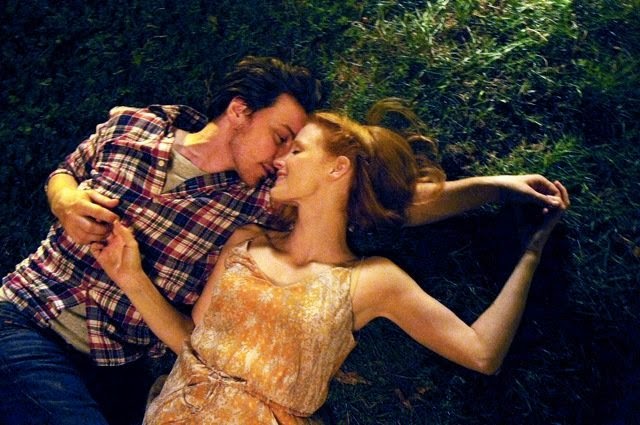
The film begins with a vignette of Conor and Eleanor at their youthful best; a playful bailing on a dinner bill followed by a nighttime park embrace amongst the fireflies that closely resembles a scene out of typical contemporary romantic flick. In one small cut, however, we see Eleanor calmly ride her bike to a bridge and jump off. She survives, but moves back in with her parents and avoids all contact with her husband.

Though what happened to bring the couple to this point is unveiled slowly, ultimately, their different methods of coping with tragedy have caused them to grow apart. While McAvoy is steady as Conor, and while the “Them” cut spends about the same amount of time on both of the relationship’s perspectives, the film still feels very much like the Jessica Chastain show. She has been masterful as both meek and powerful women (“The Help’s” Celia and “Zero Dark Thirty’s” Maya, respectively) but this is Chastain’s first big shot at the middle ground. Sometimes strong, sometimes on the verge of breaking, Chastain covers the spectrum flawlessly and in the process, crafts a character that even in the shortened version of the film, seems whole despite admittedly not knowing herself.

In his first feature film, writer-director Ned Benson fearlessly tackles his subject matter. In other hands, the film might have become the standard romantic drama its trailer makes it out to be, but Benson is not afraid to go beyond that (even if he did ultimately have to bite the bullet and cut the film down). The camera often lingers on Conor and Eleanor much longer than one would expect. In those extra seconds, however, it manages to engage the characters on a much deeper level. The pace is at times slow to a fault and some audience members may indeed stir (which leads one to wonder if the extended cut of the film will feel like overkill), but in the end, it is all put to great emotional effect.

Along the way, the film also gets some heartfelt supporting work from the likes of Viola Davis, William Hurt and Isabelle Huppert. The score, moody and melodic, features new (and currently unreleased) tracks by post-rock and alternative hip hop artist Son Lux. Christopher Blauvelt’s cinematography is, above all else, understated. Often, we simply follow the character, seeing what they see as it passes them by, yet the film always maintains a soft beauty similar to that established in last year’s “Her” by cinematographer Hoyte Van Hoytema. All of these intangibles come together exquisitely in the film’s entrancing finale.

“The Disappearance of Eleanor Rigby: Them” is one of this year’s pleasant cinematic surprises. What could easily turn out done-to-death in the hands of a first-time director instead serves as an introduction to a talented new helmer to watch, a reaffirmation of a top actress and a fresh addition to the romance genre. (Grade: B+)

Art House Appraisal is back!

Greetings Cinephiles!

After a longer-than-expected hiatus, it is with great pleasure that I announce that Art House Appraisal is officially back and here to stay. Despite being off of the blogosphere for a while, I have been watching this year's films as religiously as ever, so expect many, many reviews and top lists to come. Also, as a special treat, I will be attending several huge events at the New York Film Festival in the coming weeks. First, next Saturday I will be attending the world premier of writer-director Paul Thomas Anderson's new film, "Inherent Vice." There has been a ton of mystery surrounding this one (a trailer likely will not drop until after the premier) so expect a review the very next day to give you all a chance to gauge my reaction to the film as soon as possible. I will also be attending a special version of the festival's "On Cinema" film talk sessions with Anderson himself the following day. The event will consist of discussion of clips selected by Anderson from films that have inspired him, so expect some exclusive content from that as well. Then, the following weekend I will be attending screenings of heavily anticipated upcoming films "Birdman or the Unexpected Virtue of Ignorance" by "21 Grams" helmer Alejandro González Iñárritu and "Foxcatcher" by Bennett Miller; reviews will follow! 

Once again, welcome back and looking forward to posting soon and often!

Saturday, December 21, 2013

"Her" is a Beautiful Exploration of Love and Technology

"Her," while unconventional in concept, is an incredibly intimate exploration of the modern human relationship.
It may sound like a bad joke to say that the most intimate sex scene of the cinematic year is between a man and his computer, but that is exactly the type of magic that Spike Jonze works in his new film, "Her."

The scene features nothing more than a black, existential screen and what you might imagine phone sex between a madly-in-love couple set apart by a great distance would sound like. Unfortunately for the lovers in this case, that distance can never be lessened.

Theodore Twombly (played by Joaquin Phoenix) is at a lonely crossroads in his life. His appearance is upbeat, consisting of high-waisted pants, brightly colored button downs, thick-rimmed glasses and a caterpillar mustache, yet there is sadness in his demeanor. For work, he writes beautiful, moving love letters for clients whose relationships he traces. Though his writing reveals his sweet soul, Theodore has little use for it in his own life. The nearing end of his marriage to a woman he grew up and "experienced everything with" has left him pessimistic about life. If he has already experienced everything with Catherine (Rooney Mara, who looks much better with eyebrows), he wonders, won't everything else from this point on be redundant? In reality, the relationship has been over for sometime. All that's left is the signing of the divorce papers; the validation of an end that Theodore is not yet ready to accept.

In a moment of spontaneity, Theodore purchases a new, highly advanced operation system. He assigns the system a female voice and soon enough she has given herself a name. "Samantha," (a revelatory Scarlett Johansson) is sweet, bright and witty, and strikes a nerve in Theodore. Though he remains stuck in the shadow of his past and is not interested in real women for anything more than bodily urges, Theodore's relationship with Samantha is as honest and free-flowing as it is confounding to him. She is constantly evolving and developing a deeper desire to want, feel and experience the world the way humans do, and he, a hopeless dreamer, is looking for new ways to view at the world. He finds just that in Samantha and the two soon find themselves so deeply taken with one another that they are able to make love through nothing more than their voices.

To tell much more of the plot would be to ruin Jonze's wonderfully unique love story. It is refreshing to see such an unconventional concept treated with the delicacy and skill it deserves. The script, also written by Jonze, is wholly original and often hilarious. It is peppered with social commentary on the impact of the new age of technology on human interaction in the not too distant future (the film maintains a healthy balance between sci-fi and actuality).

The film also effectively balances humor with pathos; there are many scenes that at one moment feel like something out of a lighter comedy, yet remain one shot away from major emotional revelation. One stand out features a surrogate body service for human-operating system relationships. After Samantha experiences some difficulties in her relationship with Theodore, she hires a young woman to act as her "body" while the two make love. At first funny, the scene quickly shifts to intensely awkward viewing when Theodore finds the experience too weird to go through with and then accidentally reveals reservations he has about the relationship.

Though the film briefly delves into metaphysical matters, they are largely used as metaphors for cycles of the modern relationship, Jonze's depiction of which is perhaps the most accurate and honest in a good long while; don't be surprised if any or many of the conversations between Theodore and Samantha heavily resemble ones you've had with a significant other. As a result, all of the joy and heartbreak are palpable.

If ever a voice were to be deserving of acting nominations, it would be Johansson's. The range she is able to cover merely through intonation is deeper than most actors' or actresses' on-screen range.

Phoenix, meanwhile, is as powerful as ever. Some have unfairly labeled him as a typecast flawed wanderer, but a comparison between this role and his previous in last year's "The Master" should serve as evidence against that. Freddie Quell is a flawed wanderer indeed, but he is a volatile, rude, often thoughtless damaged soul. In that role, it is Phoenix's intensity coupled with emotional range that brings the performance to into the realm of greatness. Theodore, on the other hand, is a thinking man. He is a skilled and poetic writer in addition to a polite and socially comfortable man; his flawed wandering is only a result of his ending marriage. The characters are similar on a very thin surface layer, but, in fact, are very different. Phoenix covers both flawlessly.

Amy Adams, who seemingly can do no wrong of late, has a small role as Theodore's longtime best friend and neighbor. Her screen time is brief, but she still remains impressive as a more subtly damaged counterpart to Theodore.

Also noteworthy in the film are the score, featuring songs by Arcade Fire (like Supersymmetry, which was written specifically for the film despite appearing on the band's most recent album), and the delicate cinematography by Hoyte van Hoytema, which effectively contributes to the ambiguous yet deeply felt mood of Theodore and Samantha's relationship.

At its core, "Her" is one of the most intimate and timely romances in many years. It asks many questions of its viewers, perhaps the broadest, yet most important of which is: what makes love? Considering how intimately crafted the chemistry between Theodore and Samantha is, it's hard to imagine that Jonze is far off from an answer. (Grade: A)

Thursday, December 12, 2013

End of Semester and Stories to Come Including My Top Films of the Year


While the semester here at Rowan University is coming to a close, my posting here certainly will not. In fact, I dare say that I will now be able to post more often without the work load of classes for winter break, and I have lots planned for the coming months. 

Spike Jonze's "Her" is my most anticipated film of the
remaining cinematic year. (Photo by Warner Bros. Pictures
and Annapurna Pictures)
Check back soon for reviews of other top contenders I have seen this year as I will finally have a chance to organize my thoughts on each film (some I've seen several times) and write them full, graded reviews. Once I manage to see the remaining contenders of the year (I am most excited for Spike Jonze's "Her" at the moment) I will compile a list of my top films of the year and why I picked them. To give you a sneak preview, at the moment, my top five stands at:
Over the course of this semester perhaps the most important thing I've learned is that, ironically enough, film is not a subject that lends itself well to visual storytelling. For web video this proved especially true, as without being able to use actual footage and/or images from the film I am covering, subject matter becomes scarce. 

Photos are a little better. While it is difficult to get pictures of actors and directors without a press pass, it is not impossible. You just have to be very proactive and forceful about it; I pushed my way through a crowd of fans to get a picture of Carey Mulligan and ordered tickets for the New York Film Festival's opening screening of "12 Years a Slave" months in advance in order to be able to attend the Q and A with its director (Steve McQueen) and stars. 

Audio was the best of the multimedia storytelling options for film and I found that although it is a specific subject, there are knowledgeable sources for it all over the place, such as film professors. Film journalism, while more subjective in nature than say, news reporting, is nonetheless greatly improved by talking to those who know a lot about it.  

Below are my top five posts of the semester (in no particular order). Take a look back at them and enjoy:

Roger Ebert: the Man Who Revolutionized Film Criticism


In his book, "The Great Movies," Roger Ebert explores what are, in his view, the 100 most essential cinematic works in history. The timeline above lists those 100 by release date, director and stars. (All information is via Imdb.com and all photos without attribution are by unknown photographers and are in the public domain)


In April of this year, the film universe was saddened by the passing of "the best-known film critic in America."

Roger Ebert was not only one of the industry's most well-known pundits, he was one of its very best. Whether it was breaking new ground in becoming the first film critic to win the Pulitzer Prize for Criticism or his infamous on air reviewing of films during which he would coin the now common place idiom "Two thumbs up," Ebert was able to do what few critics before him could: popularize film criticism.

In a way, what Ebert did for film criticism is similar to what director Steven Spielberg did for the movie industry with the marketing and release of his 1975 thriller "Jaws." In the film, Spielberg created a first of its kind: the high concept film, or a film of a simple premise that can be easily pitched in 25 words or less. "Jaws" went on to become the first film to gross over $100 million in rentals and effectively built the summer blockbuster secret to box office success we know today.

Ebert, on the other hand, brought the secret of mainstream success to those who write about film. Not long after he started his career as a film critic in 1967, Ebert was already gathering attention for his work. Pauline Kael, who is widely regarded as the most influential film critic of her generation (right before Ebert's), called Ebert's early columns "the best film criticism being done in American newspapers today" shortly after she first read them.

Soon, Ebert, on the heels of his successful start in the business, became a co-host on a weekly film review television show called "Sneak Previews." Though the show started out as a local production in Chicago, it was soon picked up by PBS and shown to audiences nationwide.

Over the years, the show continued to draw successful ratings even through a number of network and name changes. It arguably reached it's most well-known period as "Ebert & Roeper and the Movies" from 2000-2002 when Ebert's fellow Chicago Sun-Times columnist Richard Roeper joined him as co-host.

"I remember the show being a big hit right away," said Raritan Valley Community College film professor and Ebert acquaintance Mark Bezanson. "I think that the show reached a lot of people, not just because it was accessible physically on television, but because it was accessible on a critical level. A lot of film critics talk in a sort of pretentious code, and Ebert took all that and put it in people language so to speak."

"The 'two thumbs up' thing didn't hurt the appeal either," Bezanson added.

Roger Ebert is remembered as the most well-known film
critic in America. (Photo owned by Roger Ebert)

What set Ebert apart from other film critics, in addition to his television exposure, was the simplicity of his critical style. He utilized straightforward film rating techniques such as a four star system as opposed to the many other wider ranging systems used, like one-to-10 scales. He also invented and trademarked the "two thumbs up" phrase which rated a movies success based on whether it received thumbs up or down from Ebert. The phrase quickly garnered universal appeal as it gave many the opportunity to quickly decide whether or not to see a film.

"The 'two thumbs up' thing was a big help when my husband and I would try to plan a weekend trip to the movies without the kids," said film fan and mother of three Carol Paterno. "I love movies but I never really had time to figure out what was worth seeing when they were little. And Roger Ebert was normally right so it became a pretty reliable thing for us."

In addition to gaining the approval of general audiences, Ebert also became popular with film insiders, particularly those with a taste for experimental films not popular with mainstream audiences, because of his approval and openness to such films.

Though he did not like the idea of top 10 lists, one he submitted to the 2012 Sight & Sound poll of the greatest films of all time included both Stanley Kubrick's 1968 evolution epic, "2001: A Space Odyssey," and Terrence Malick's 2010 wide-scaling life meditation, "The Tree of Life." The two films are examples of art house features with cult followings from both past and present eras and, upon release, each had just about as many detractors as they did admirers. Ebert praised them as two of the greatest of all time, however, in what was his signature "relative, not absolute" style of reviewing.

Interestingly enough, the beginning of Ebert's popularization of film criticism came in the same year that Spielberg reinvented the box office equation. Ebert first started as a television co-host in 1975, the same year "Jaws" was released. Ebert said of the film: "There are no doubt supposed to be all sorts of levels of meanings in such an archetypal story, but Spielberg wisely decides not to underline any of them. This is an action film content to stay entirely within the perimeters of its story." He knew how the film would revolutionize the business; he was in the process of doing the same to his own.

Saturday, December 7, 2013

The Rise of Writer-Director Paul Thomas Anderson

(Photo by Jürgen Fauth)
When any contemporary director is compared to the likes of Stanley Kubrick and Orson Welles, you take notice. No one in recent years has drawn more comparisons to the great auteurs than former film wunderkind and current American heavyweight Paul Thomas Anderson. From box office hits like 1997's unique look into the 70's porn industry, "Boogie Nights," to more experimental art-house efforts like 2012's "The Master," to sprawling epics like 2007's "There Will Be Blood," Anderson has already proven himself one of the most talented and versatile directors in the world today. Here is a look at how Anderson has risen to such heights just six films into his career:

Tuesday, December 3, 2013

"Prisoners" is a Skillfully Woven Maze in Search of an Ending


Hugh Jackman's intensity in "Prisoners" is something to behold.
Canada is slowly becoming a hotbed for compelling contemporary cinema. With time-hardened directors like James Cameron (“Avatar”) and David Chronenberg (“Eastern Promises”) still working their magic in addition to up-and-coming talent like Sarah Polley (“Away From Her”) producing increasingly interesting films, Canada’s stock is very much on the rise. Canadian director Denis Villeneuve proved himself an emphatic part of that field in 2010 with his highly touted family drama “Incendies,” and his latest film, “Prisoners,” continues his streak.

The film opens with a shot of a deer grazing through snowy woods. As the camera creeps backwards the tip of a shotgun comes into view, a prayer is whispered and the deer is slain. Here, innocence is overtaken by the crueler workings of the world, a sign of things to come for the hunters, Keller Dover (Hugh Jackman) and his son, Ralph.

Dover, his wife Grace and his two children, teenage Ralph and six-year-old Anna are visiting their neighbors for Thanksgiving dinner. Franklin and Nancy Birch (Terrence Howard and Viola Davis) have two children as well, teenage Eliza and six-year-old Joy. While taking their younger sisters on a walk, Ralph and Eliza spot an unfamiliar RV parked on a nearby street. The two stop their sisters from playing on it, and take them back. Soon after returning to the Birch residence, Anna and Joy ask to walk back over to the Dover household to look for a red whistle Anna was given by her father. It is lost, and so too become the little girls. When the two little girls go missing, the disappearance of the strange RV becomes the focus of the two panicking families.

Enter Alex Jones (Paul Dano). As the owner of the RV, Jones very quickly becomes the prime suspect in the kidnapping. It does not help his case that although tall and lanky, he is dressed like a 10-year old, has a far off look in his eyes and speaks in high-pitched, broken sentences. Despite being taken into custody, no evidence of any kind is found on Jones or his RV, and he is soon released to the care of his aunt and guardian, Holly (an almost unrecognizable Melissa Leo). Outraged by the police’s handling of the case, particularly a broken promise to keep the suspect in custody by Detective Loki (Jake Gyllenhaal), and vehemently certain that Jones is guilty and knows the whereabouts of the girls, Dover takes it upon himself to move the case forward and subsequently kidnaps the suspect.

Dover brings Jones to a boarded up and abandoned house in a presumably quiet part of town and begins to attempt to beat the whereabouts of the girls out of him. Jones says nothing, so Dover is forced to call upon both Franklin and Nancy for help.

Here, the film asks serious moral questions of its audience. Franklin is horrified by Dover’s actions. He knows it’s not right, yet at the same time there is the pull of the clock ticking on his chances of ever seeing his daughter again. How far are you willing to go to save a loved one? Should you be willing to go that far? Is it acceptable under these circumstances, or any for that matter?

“In the maze,” Jones tells Dover between scalding showers in a wooden cell. “That’s where you’ll find them.”

Dover has no idea what this means, of course, but “the maze” is a recurring symbol throughout the film and also effectively serves as a metaphor for each characters struggle; each is trapped in a seemingly inescapable maze. Franklin and Nancy are trapped between their guilt in allowing Dover to brutalize Jones and their desire to save their daughter; Jones is trapped in both the physical confines of Dover’s torture and his own mental confines, as there is very obviously something preventing him from telling what he knows; Anna and Joy are trapped in the hands on their abductor; Dover is trapped between the desperation to find his daughter and the growing likelihood that he will not be around to provide for her (should he find her) once the police discover what he is doing with Jones. Each character is a “prisoner” to his or her own maze.

Though the storyline asks compelling questions of its viewers, it is its haunting cinematography and score that lift it to its highest points. Academy Award nominated cinematographer Roger Deakins (“The Shawshank Redemption,” “No Country for Old Men”) instills a constant sense of dread and filth throughout the film with his often jarring, yet always visually compelling camera work. Jóhann Jóhannsson’s original score, meanwhile, shows deep range; from slowly building the suspense and dread involved in the mystery of it all to the emotional weight the events take on those involved, Jóhannsson covers it flawlessly.

Another driving force of the film is its intensity. Jackman’s performance comes to the forefront for sheer explosiveness and effective transparency; his eruptions are not of ultimate assurance, but rather a lack thereof he is compensating for. The performance of Gyllenhaal as Detective Loki, while not as forthcoming as Jackman’s, is nonetheless a major part of the foundation of the film’s sense of dread. He has a facial tick that grows more and more prominent as tension builds in the plot. He is implosive, appearing calm and collected throughout, his deterioration only noticeable through the slightest of details until he finally explodes in one of the more compelling set pieces of recent years.

Where this film loses steam, however, is in its latter half. While suspense built is constantly rewarded with real results throughout the first half of the film, it is repeatedly left empty as the film nears its conclusion, which turns out to be its weakest point. There is a very distinct difference between an effectively ambiguous ending and a non-ending. “Prisoners,” unfortunately, for all its ambition, features the latter.

Perhaps more so than any other film in recent years, "Prisoners" is a half film. Er, about three-quarters of a film to be more specific. It is almost as if Villeneuve got injured and sat out the fourth quarter, leaving a substitute to try to bring home the win. Though there is much to appreciate in "Prisoners," the fourth quarter is crunch-time and taking it off does not lead to victory. (Grade: C+)